By Robbie Armstrong
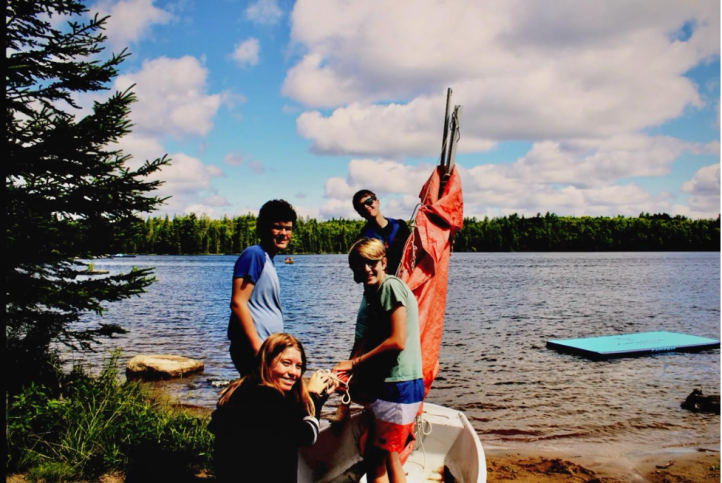
“Brace for impact!” yelled George. I whipped my head around just in time to see the steel hull of a motorboat careen into the side of our tiny sailboat, pushing its starboard side into the cool water of Teepee Lake. George ducked as the boom tore free from its place on the mast, crashing overboard beside him. “Abandon ship!” I called as I dove into the lake; Grass and George were soon behind me as we watched weeks of our hard work capsize in front of us. Despite its catastrophic ending, the maiden voyage of the rickety boat we called Tarpti–for the torn orange tarp serving as its sail–had been a success surpassing our greatest expectations. As we climbed onto the vessels that had arrived to rescue us from the disaster scene, we pledged to do even better the following year. Enter the snipe.
As the sun rose one warm day in July 2024, I sat on the sail dock at Camp Arowhon and envisioned my latest dream: a sailing boat twice the size of the previous year’s Tarpti and speedy enough to outflank even the camp’s own RS Zest boats. My plan was to cannibalize parts from the long-retired Snipe class race boats sitting derelict across the camp to build the craft of my dreams. I walked across the dock to where Imo, the young, new head of sailing, was tending to a motorboat, and I pitched her my idea. “Absolutely,” said Imo excitedly. She had grown up in the era of the Snipes and was eager to see one return to the lake. She recommended I speak to the enthusiastic camp director about my plan. At well over six feet and with an impressive build, Max Muszinski is often viewed as an intimidating figure. He is, however, well known for his eccentric passion for sailing. He provided us with the iconic orange tarp that served as the sail for our first sailboat the year before and was more than happy to assist again. “We’ll need a sail, a jib, a mast, a boom, a rudder, a centreboard, and most importantly, a hull,” I told him; a smile illuminated his face as he relived memories of his days on the snipes.
He opened the door to his ATV and beckoned me into the passenger seat. We drove up a hill and into North Camp, past the barn and onto a small trail. After a few minutes driving through the forest, we arrived in a small clearing filled with ancient watercraft—canoes, trailers, and, most importantly, boat hulls. Max and I grabbed the ends of a boat and turned it over. Hull 17, or the Grey Goose I as she was known previously, was not a pretty sight. The 18-foot craft had not seen the water in almost a decade, and it showed. However, the warped fixtures and thick dirt covering the ship did not deter me: “I’ll take it!” I exclaimed, giddy at the prospect of my dream starting to materialize. I sprinted back into camp and gathered some people to help. Hayden, the head of climbing, and Oísin, a senior counsellor, volunteered, and the three of us trudged back to the clearing in the woods. With Max’s help, we raised the almost four-hundred-pound boat onto the trailer. Max climbed back into the ATV and hauled the boat to the beach.
The second order of business came the next day. I pushed the boat into the cold, glassy lake and heaved it onto its side. With sponges and a bucket, George and I cleaned the hull. Once satisfied that the dirt and detritus had parted from the fibreglass hull, I walked toward the boat house. Constructed in 1932, the boathouse is the oldest building in camp and fittingly holds most of the vintage sailing parts. I stepped into the boat house and gazed upward at the twisted web of metal and wires. Climbing onto a bench to reach the rafters above, I gingerly pulled a mast down from above, careful not to separate any cables. The mast joined the hull, and a rudder was found by maintenance.
A grey sky and damp wind made for harsh conditions on day 3 of construction. Despite the weather, I hurried to the sailing dock to begin work. “I found one!” called Max from his balcony overlooking the dock. I saw him triumphantly holding a massive white sail above his head. The sail was the most significant construction concern as we had been unsure if any had survived the many years spent in storage; thankfully, Max had found a complete set. With help from Imo, we slowly unfurled the majestic white sail emblazoned with the ship’s name. Eager to test the new sail, Imo and I lifted the mast above our heads and stepped it into the hull. Little did we know, the connector at the bottom had corroded away after spending years in the forest. Elated and unaware of the impending problem, we continued testing by attaching the boom and, for the first time, running the sail up the mast. We turned around to take a picture when we heard a groaning metallic screech from the boat.
Snap!
The three of us watched in horror as the forestay cables snapped in the wind, bringing the 22-foot mast crashing onto the beach.
The mast assembly was ruled a complete loss after the accident. Disheartened, I set about finding a new mast. With help from Imo and Hayden, one was found and installed on the fifth day of construction. Max came down towards us as we finished our work, accompanied by a man with a round face, short dark hair, and black glasses. “This is Grant Goldberg,” said Max, “He was the head of sailing here for many years.” Grant had gotten wind of our boat-building ambitions and took a detour from his canoe trip to inspect our progress. Grant held an intimate knowledge of Snipes that none of us could ever dream of possessing; he had sailed the type for almost a decade. With his assistance and expertise, we carefully strung the sheets and ropes together to put the finishing touches on the boat.
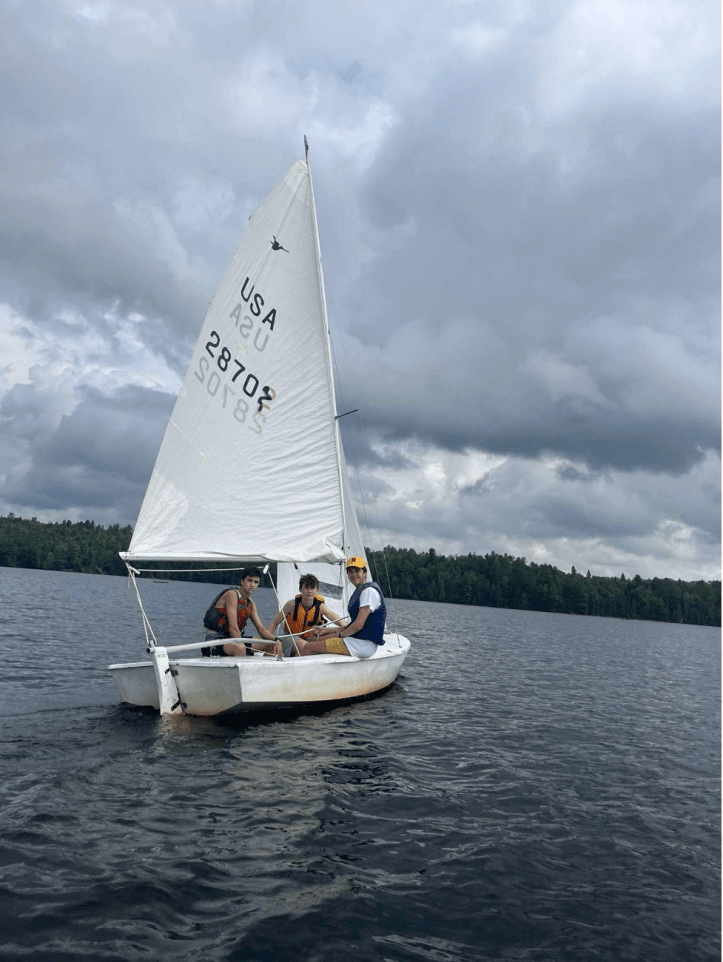
The proudest moment of my summer was watching the magnificent white sail loft into the air for the first time. Joined by former head of sailing Maya Kerzner, I pushed off from the dock and headed towards the buoy in the lake’s centre. With one swift rudder motion, I became the first to perform a buoy rounding at Arowhon in over five years.
A month later, as camp was coming to an end, the time came to say goodbye to the Snipe. I enlisted the assistance of Zane and Gabo–two LITs not known for their sailing prowess–and together, we prepared for her final voyage. With a motorboat circling, we aimed the boat at the beach and increased speed to full. “Brace for impact!” I yelled, preparing to ram the beach. We struck the beach and glided gracefully to a halt.
I shook hands with the crew and furled the boat for the final time. The mast and sail were removed and placed inside the hull. Max strapped the hull onto his trailer and, with me in the passenger seat, drove back to the clearing in the woods, where we had begun our journey almost a month and a half earlier. The Snipe rests, enduring winter, awaiting summer.
 The Howlander