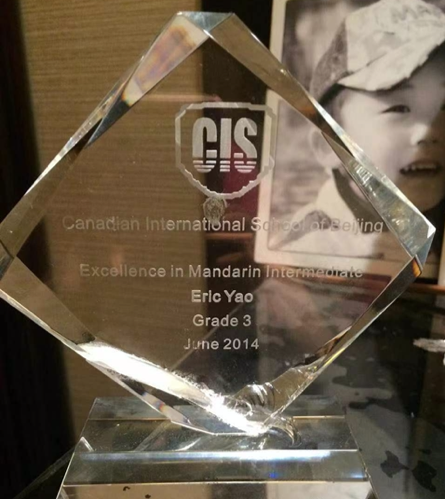
By Eric Yao
The loud sound of applause was overwhelming, making my face burn as the teacher handed me my award, a large piece of glass with “Eric Yao, CIS Excellence in Mandarin” clearly engraved on it in silver. I stood on the stage in awkward silence until the few in my grade received their awards. I knew there was an ocean of people around me, watching me. My classmates, parents, older students, and teachers were all down there, and if the lights from the stage didn’t stop me from seeing how many, I could have fainted. When I was walking back to my seat, 12 rows in the back, I could feel the award dragging me down like I was imprisoned. Millions of eyes watched me like hawks staring at a trembling rabbit. My mind, however, was focused on one question, “how did I get this award?”
I wasn’t the brightest among my classmates. At eight years old, I was chubby and one of the few tall kids in my class. Despite my intimidating appearance, my personality was the opposite. I was extremely shy, and I avoided unnecessary social interactions at all costs. Thus when it came to going on stage, it felt like I was standing next to a guillotine, waiting to be executed. I was also one of the few kids who could give teachers headaches, making them want to quit their job after teaching me. It wasn’t because I didn’t learn things fast enough; it was the opposite. I learned concepts at a surprising speed, but I wasn’t the best with performance and responsibility. I held the grade record for not doing my homework for months in a row, constantly getting 2 out of 10 on my spelling tests, and seeing twos hit my report card like tsunamis. I was a part of and apart from the rest of the kids. I was a kid who challenged rules, but one who had many friends. Despite my failure in all my other courses, I was at the top of my class in Mandarin. It wasn’t that impressive, but it was enough to prove my intelligence.
To be honest, my high grades in Mandarin weren’t because of my interest in the subject. The only reason I paid attention in that class was because of a bet I made. Looking back at myself, my obsession with Yu-Gi-Oh cards was over the top. My grandmother used this weakness against me, and we made a bet. She said that every time I scored 100 on my test, she would buy me a pack of cards, which eight-year-old me considered a good deal. It was like feeding meat to a tiger, and you could see my mark skyrocket. Even my teachers said that I changed surprisingly, but I was too focused on Yu-Gi-Oh to care about their thoughts. My life continued as usual, and I didn’t do any homework until my teachers or mom screamed at me. Against their constant complaints about my schoolwork, I would always pretend I was doing it when I played an online game with my friend Vince. My classes were often cut short as I would go to the washroom for half an hour at a time. Despite being such a naughty kid, I still felt supported by my family, especially my grandparents.
As I walked back from the school’s auditorium to my class, my brain was spinning rapidly, thinking about how I should respond when my friends and teachers congratulated me. The congratulations from parents and teachers went in one ear and out the other. I didn’t want to respond, or maybe I was too afraid, or nervous — I don’t even know. I was too focused on the award, every edge of it, every word on it. My brain came up with all the possibilities of where this award could be displayed in my room. Was it going to be on my desk or my shelf? As I entered my classroom, my teacher congratulated me, and I had a smile brighter than the sun. I walked over to my locker beside the door and picked up my backpack from the bottom. I felt the reasoning part of my brain try to convince myself to put the award in the bag, but I liked it too much, as if it was a part of me, so I ended up holding it like a child — possibly the biggest mistake in my life.
The grade three classroom was on the third floor of the main building. As a kid, everything seemed massive, and even the stairs appeared double the size they were. I started walking down the stairs, still pondering why I had been chosen for this award because I knew I wasn’t the best in my class, nor did the teacher like me. I suddenly felt a strong wind engulf me, a wind strong enough to clear all the happy thoughts in my mind. I felt something lift my leg, probably one of the monsters in my imaginary world that I imagined every night. Right after that, I felt my body falling forward like a tiger diving for prey, except I was trying to grab hold of the award. It flew away from my hands, and I felt my soul leaving my body. It happened too quickly, too quickly for an 8-year-old to react. Consequently, I felt the back of my head hit four steps of stairs at different angles, and my teeth bit down on my tongue. My eyes turned black, and I felt my body hitting the waxed floor with extreme force, and the award landed beside me. After a short moment, I heard a teacher calling my name, and I felt the hands of some older students holding arms, trying to lift me. I stared at the teacher, muted, trying to comprehend what happened and the words coming out of her mouth. I simply couldn’t.
The next thing I knew, I was sitting in the nurse’s office with blood on the side of my face. There was a cut on the left side of my eye, and the mixture of blood and tears covered my face, making it hard to see. Surprisingly, I didn’t get a concussion. Sitting next to me was my award, in pieces. And there it was, my first product of hard work shattered in front of me. The image hit me with emotions too complicated for me to understand. Was it sadness, or was it anger? I was too confused to know. I tried to keep my eyes off of it by staring at the ticking clock on the wall, waiting for my parents or anyone in my family to come. Every tick felt like ten years. Eventually, the wooden door opened with a cracking sound, and I saw a familiar face. “What happened, Eric?” my mother asked when she walked in. I didn’t want to explain, and I physically couldn’t because of my bleeding tongue. My eyes turned naturally to the nurse, prompting her to explain the entire scenario, so she did. I walked out of the school speechless, hearing my friends’ parents congratulating me and my parents, but my lips were trembling too much to respond with anything. It was my last day of school at CISB, my last day of school in China, and it ended like a dramatic movie.
After I walked into my house, I didn’t cry, I didn’t scream, I didn’t do anything a normal 8-year-old kid would do. I stared at the pieces of the award on my table, and I felt empty, as if I never got the award, or it was never meant for me. No, it was a lot worse. I tried to get myself together by playing video games and sleeping more than usual, but that didn’t compensate for the damage I felt.
When my dad got home, he walked into my room with a tube of superglue in his hands. I knew he could fix my award, just as he could fix anything I broke. He walked up to me, clearly not happy with the number of video games I played, and he placed his hand on my head. I hated it when my dad did that as if he was petting me like a puppy. I stared at him, emotionless, and he stared back with a metal face. All of a sudden, his face softened, and he sat on my bed. “Listen, Eric, I know what happened, your mom told me. What’s done is done, so don’t think about it anymore. We can still fix it. Next time, be more careful when you’re walking down the stairs.” I wanted to scream. I wanted to yell, “I can’t control whether or not I fall!!!!” But I didn’t. I was too tired, too stressed from the day, and possibly too scared of my dad to scream at him like that. I refocused my attention on my unfinished game. A few hours later, my dad walked into my room again, with the award glued back together. The crack marks on it were still visible, but it was better than having pieces of glass on my table. I didn’t know what to think or say, so I just accepted the fact that it is what it is.
To me, that award was my first success, an artifact that marked the end of my life in China, and something that split my childhood in half. After all, my sense was correct; that award did not belong to me. The award shattering into pieces not only changed me as a person but also taught me to work hard and be more careful. My life in China was uneventful, and I was a horrible student, but it taught me to value hard work and embrace success without second thoughts. Although years have passed, this memory constantly flashes in my head, and I’ve made a vow that I want every award I get to be something I deserve and something I worked for. Every time I go on stage to get an award, I remind myself not to drop it. If I hadn’t dropped that award early on, I may have overlooked opportunities to be successful since then.
 The Howlander